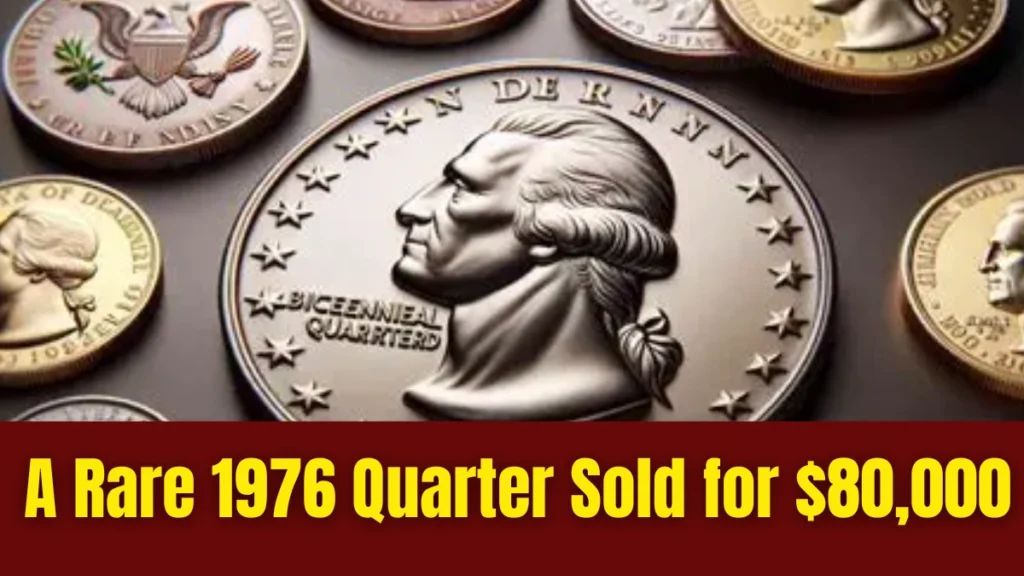
A Rare 1976 Quarter Sold for $80,000– The 1976 Bicentennial Quarter is one of the most recognizable U.S. coins ever made, featuring the drummer boy design and dual date 1776–1976. Millions of Americans still have them in old jars, boxes, and coin albums. But what most people don’t realize is that certain rare Bicentennial Quarters are now worth up to $80,000, turning everyday pocket change into unexpected treasure.
Why the Bicentennial Quarter Became Valuable
A Rare 1976 Quarter Sold for $80,000: The U.S. Mint produced these coins to celebrate 200 years of American independence, leading to massive public excitement. While billions entered circulation, only a tiny number had qualities that turned into major collector prizes decades later. High-grade silver versions, dramatic mint errors, and unusually sharp strikes are the biggest reasons some coins have skyrocketed to astonishing values.

The Rare Bicentennial Quarters Worth Up to $80,000
Though most Bicentennial Quarters remain common, certain special examples command huge prices. A handful of 1976-S Silver Bicentennial Quarters in ultra-high Mint State grades have topped auctions because they survived in nearly flawless condition. Even more valuable are dramatic minting mistakes — including double-die varieties, off-center strikes, and transitional errors — which collectors aggressively compete for whenever they appear in the market.
How The $80,000 Sale Happened
One of the most surprising sales involved a silver Bicentennial Quarter graded at the highest levels by a major certification company. Its exceptional shine, razor-sharp drummer-boy detail, and pristine surfaces placed it among the best-preserved examples in existence. As collectors searched for top-tier Bicentennial pieces, bidding escalated until it reached an astonishing price point near $80,000 — a record for this popular modern coin.

How to Check If Your Bicentennial Quarter Is Valuable
Start by checking the mint mark above the date.
A coin with an S may be a silver collector version, which carries higher value. Silver Bicentennial Quarters have a bright, clean edge and a slightly heavier feel. Next, examine the condition. Original shine, no deep scratches, strong drum-line details, and clear lettering indicate higher quality. Any unusual doubling, misaligned strikes, or missing elements may signal a rare error — the category most likely to reach high auction values.
Proof Sets and Silver Sets are Key Sources
Some of the most valuable Bicentennial Quarters never entered circulation. They were struck specially for collector sets containing 40% silver. If you have an old proof set or silver set at home, there’s a chance you have a coin with exceptional strike quality. These sets often remained untouched, which is why they sometimes contain the rare ultra-high-grade coins that collectors chase today.

Other Bicentennial Quarters Worth Money
Even average copper-nickel versions can bring strong premiums if they carry minting mistakes. Missing clad layers, die caps, broadstrikes, and double-die varieties are all sought after and can bring hundreds or thousands depending on rarity and condition. High-grade examples graded by PCGS or NGC also continue rising in value as more people enter the coin-collecting hobby.
Conclusion: The 1976 Bicentennial Quarter remains one of the most iconic American coins — and now, one of the most surprising sources of hidden value. While most are worth little more than face value, rare silver versions, exceptional strikes, and dramatic mint errors have sold for tens of thousands of dollars, with the top examples reaching $80,000. Checking your old jars or inherited coin collections could reveal a treasure hiding in plain sight.

Disclaimer: This article is for informational and news-reporting purposes only and should not be considered financial or appraisal advice. Coin values depend on grading, rarity, market demand, and professional authentication.