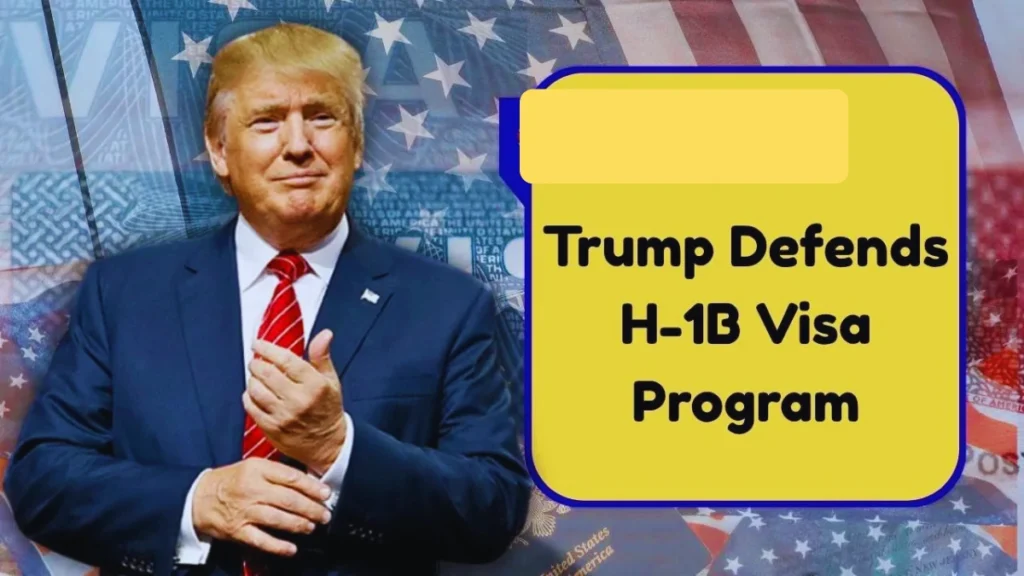
Former President Donald Trump has sparked new debate by publicly defending the H-1B visa program, stating that the United States “does not have enough highly skilled workers” to fill essential roles in technology, healthcare, engineering, and research. The remarks come at a time when U.S. companies continue to report severe talent shortages, especially in STEM-related fields.
Trump, who once criticized the H-1B program for being misused by some companies, now emphasizes that America must remain competitive by allowing top global talent to work in the country. His statement is seen as a shift toward supporting legal, high-skilled immigration while calling for stronger oversight to prevent fraud or abuse.
Why Trump Says the U.S. Needs H-1B Workers
Trump argued that certain highly technical roles in artificial intelligence, cybersecurity, biotechnology, robotics, and advanced engineering cannot be filled fast enough with the current U.S. workforce. Many American employers agree, reporting that domestic talent pools cannot meet demand, especially in fast-growing tech industries. The H-1B program, according to Trump, ensures that critical jobs are not left empty and that innovation continues at a competitive pace.
He added that America must attract “the best and brightest” to strengthen national economic growth and maintain its leadership in global technology and innovation.

What This Means for the H-1B Program Going Forward
Trump’s renewed support suggests that future policy proposals may focus on expanding or restructuring the H-1B program rather than limiting it. This includes higher wage prioritization, stricter employer verification, and improved pathways to permanent residency for exceptionally skilled foreign workers.
Tech giants such as Google, Microsoft, Meta, and Tesla have long relied on H-1B hiring to fill skill gaps. Trump’s comments may encourage broader political support for reforms aimed at improving the program while maintaining strong protections for U.S. workers.
Key Proposed Reforms in the Discussion
| Reform Category | Possible Change for H-1B Workers |
|---|---|
| Wage Prioritization | Preference for higher salary roles |
| Fraud Prevention | Stricter employer verification |
| Pathway to Green Card | Faster PR options for top talent |
| Cap System | Potential increase or restructuring |
| Skill-Based Selection | Move away from random lottery |
These reforms would make the program more competitive while boosting transparency and worker protections.
Impact on Employers and the U.S. Economy
With ongoing shortages in STEM fields, businesses say H-1B talent is essential to maintaining productivity and global competitiveness. Employers argue that without access to skilled foreign workers, innovation may slow, startups may struggle to grow, and the U.S. could lose ground to countries with more flexible immigration policies.
Sectors most affected include:
• Artificial Intelligence
• Cybersecurity
• Software Engineering
• Medical Research
• Robotics & Automation
• Renewable Energy Technology
The Biden and Trump camps—despite ideological differences—both acknowledge the country’s need for high-skilled labor, though their approaches to managing the visa program differ.
Reaction From U.S. Workers and Immigration Advocates
Reactions have been mixed. Supporters say the H-1B program is essential for closing skill gaps and keeping the U.S. at the forefront of innovation. Critics argue the program could suppress wages or disadvantage domestic workers if not properly regulated. Immigration advocates view Trump’s shift as a sign that bipartisan support for skilled immigration may grow.
What H-1B Applicants Should Expect Next
While no final policy has been enacted, Trump’s comments signal the possibility of:
• A more favorable environment for skilled immigrants
• Increased H-1B caps or revised selection criteria
• Improvements to processing speed
• More accessible pathways for exceptional talent
Immigrants, employers, and attorneys should monitor announcements from both USCIS and future campaign platforms.
Frequently Asked Questions
Q1: Does this mean Trump will expand the H-1B program?
It is possible. His remarks indicate support for legal, high-skilled immigration.
Q2: Will reforms affect current H-1B holders?
Reforms typically apply to new applicants, but some may benefit current workers if green card pathways are improved.
Q3: Does the U.S. really lack skilled workers?
Yes. STEM-related industries report persistent shortages in specialized fields.
Q4: Is the lottery system expected to change?
A wage-based or skill-based selection system is being discussed.
Disclaimer: This article is based on public statements, industry reports, and ongoing policy discussions. Final immigration policies may vary depending on USCIS regulations, congressional action, or future administrative changes. Readers should refer to official government sources for the most accurate updates.